
God and Human

Do you mind if I tell you the story about an image?
I want to show the image I created to you first, but I also want this story to make sense, so bear with me, the point is more theological than historical or analytical or art.
This essay is called God and Human because I want to do a Theodivergent thing with how we think about both God and Humanity. For most of us, our starting point is thinking that God created humans, but didn’t need to and often regrets it, like in the Garden, like with the flood, like with Babel, like with Egypt, like with a hundred other things. Basically, God is good…all the time; and humans suck…all the time? If I’m Calvin I guess I have to say yes, because that’s his theology and he legitimately sucked as a dude, Christian, yada yada yada…all the time.
I’m in Barcelona this week, writing in a coffee shop near the end of my trip, reflecting on the adventure / writer’s retreat. It’s been a great week of art and ideas.
I’m sure you’re familiar with this Michelangelo painting, right?

But then while visiting one of the modern art museums in Spain, I see this Banksy work and I start thinking—
We call this The Flower Thrower because Banksy is making a point about replacing violence with beauty. It’s all really sweet and loving even though the main emotion I feel from this “thrower” is anger. But this leads to my next thought: the outstretched hand looks like Adam’s hand in Michelangelo’s painting…and I get a little weepy with all of the implications that run through my mind in that 2 seconds:
God is working toward healing The Thrower’s situation and reaching out toward creating (The Michelangelo painting is called Creation of Adam).
Where there is death and destruction, God wants to bring life.

So then I start thinking about God’s hand on the other side reaching out. By the way, there are like a thousand interpretations of God’s index finger and all that stuff, so depending on your art history teacher or tour guide at the Sistine Chapel, you may have one of a thousand interpretations in mind as I write this.
So I tried to create that image thinking I was being clever, but then I started to follow the white rabbit (yes, Alice in Wonderland, but you’re thinking cute-kid-story and if that’s true, then you are missing the point of the ludicrousness and chaotic-creativity of Lewis Carroll).
Which leads to me play with GPT and thinking about different outstretched hands. And two of my favorites outstretched hands are Babe Ruth pointing to the outfield fence because he just predicted an important home run.
The other is the first movie I tried to watch in the cinema, but screamed when I saw E.T. But E.T.s glowing finger is burned in my mind for what I think about when I think about healing. “Ouuuuch.”
So I had this idea:
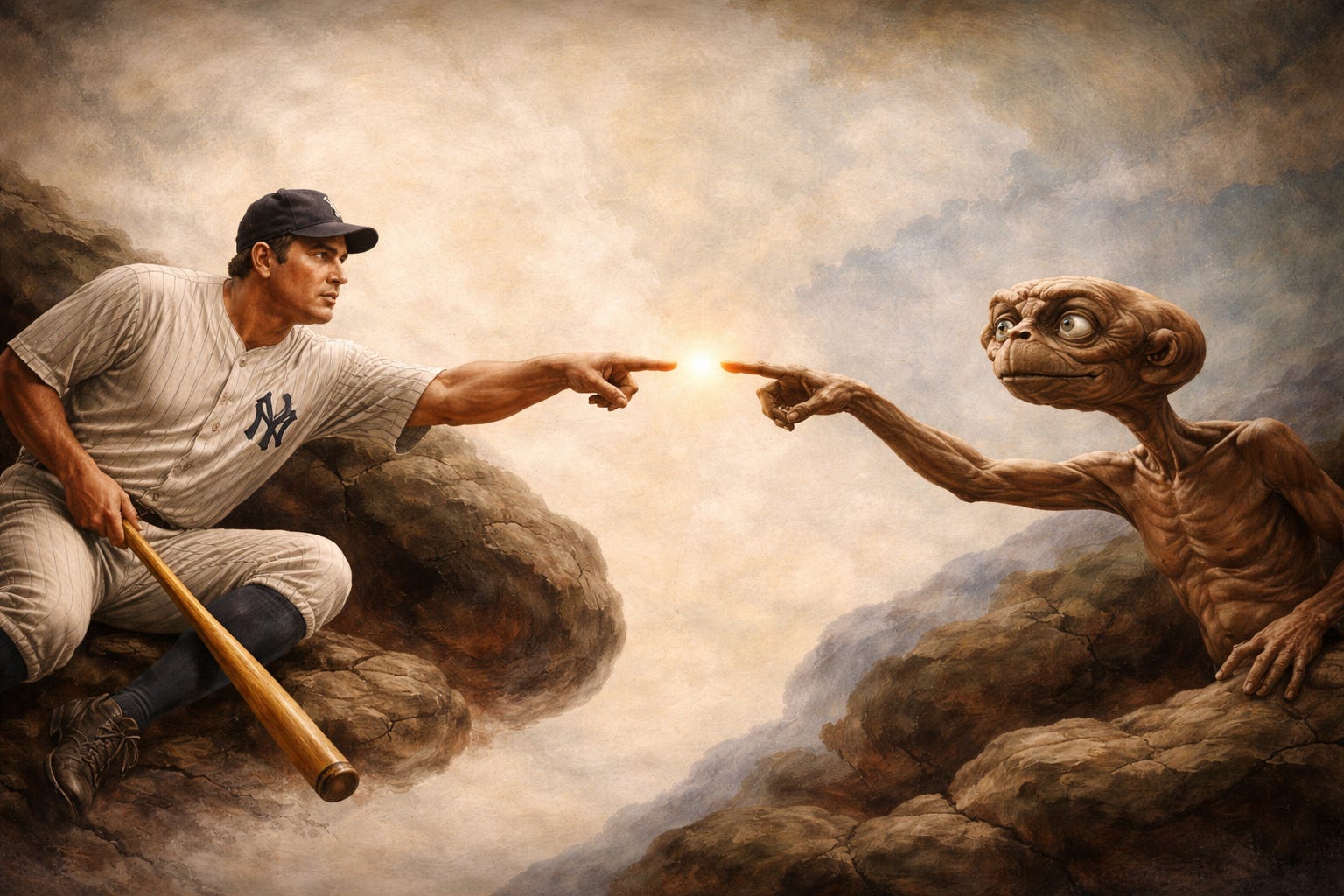
In this image it looked like E.T. (a out of the world figure) gave power to Babe Ruth (to have the power to accomplish a goal, or to co-create something legendary, or whatever).
But GPT is nuts and created this:
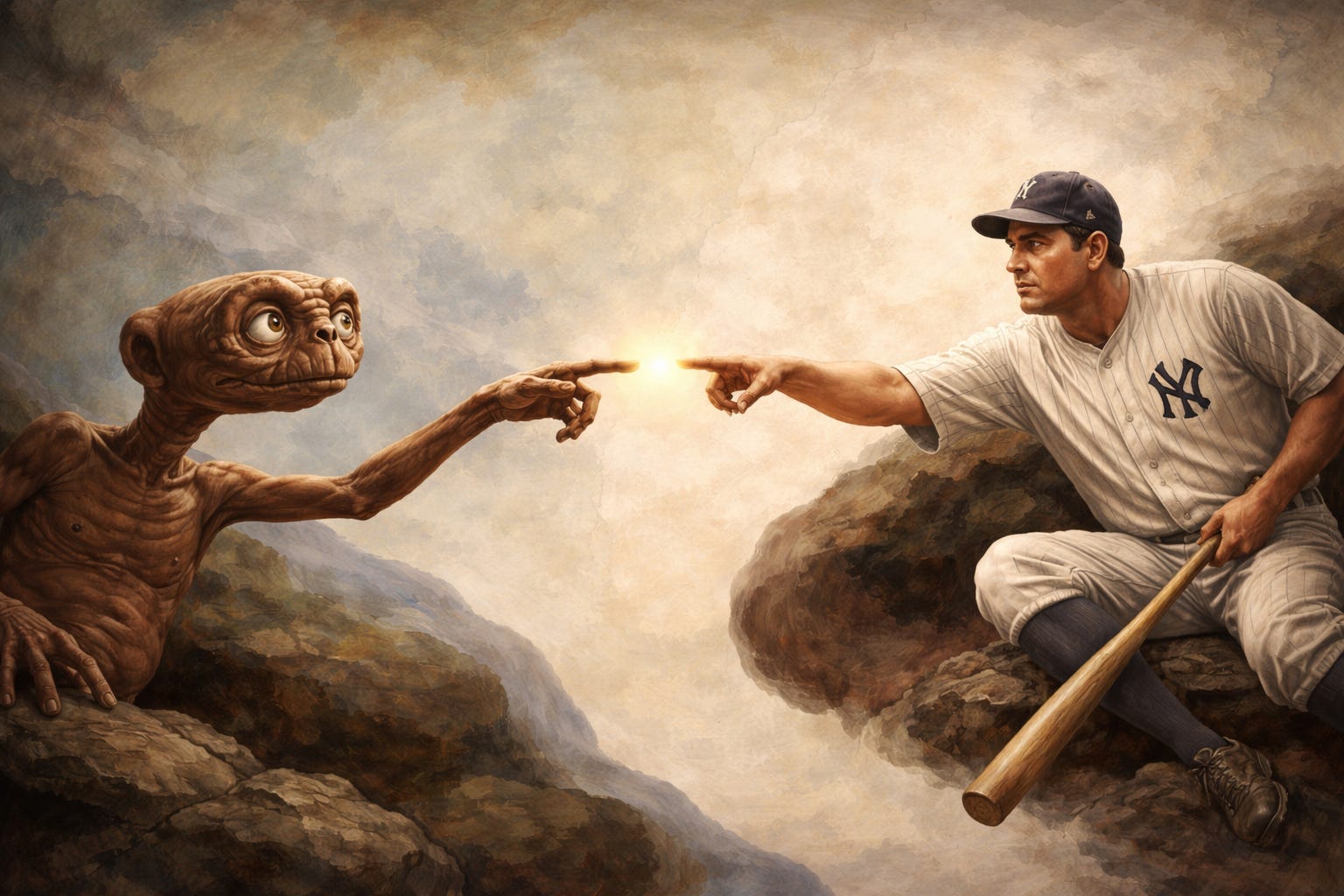
And here is my own crazy mind for you to analyze and dissect:
I haven’t been able to stop thinking about it, mostly because of the main project I’m working on which about the human capacity for great beauty and great destruction (see this whole blog for how that works together).
Ok, I’ll slow down just a bit here because I sense I’m getting ahead of myself.
Healing has all kinds of implications about physical and emotional and spiritual damage. So I wanted to show how we might think differently about healing.
Home has implications about belonging and safety and family. So Babe Ruth pointing to a HOMErun and E.T. desperately wanting to return home, got me thinking that this GPT hallucination had a greater impact for how I think now about my Human-Capacity presentation.
Here’s just one thought of many:
Babe Ruth makes a prediction to benefit himself. E.T. seems to be able to help everyone but himself. So E.T. reaches out with the glowing finger with desperate hope (which I have said in my favorite poem by me that hope is a vindictive bitch), and Babe Ruth is also hoping to reach home, they have mutually benefitted each other. Babe Ruth’s prediction is memorialized because his prediction came to fruition in a crucial moment in baseball history and E.T. is able to return to his home planet and everyone lives happily ever after until Hegseth says we’re bombing the fuck out of little kids so that Jesus can return.
There have been millions of worse moments, even in the name of God and Jesus, but this is the one I’m thinking about right now.
You see, John Calvin gave us a shitty form of Christianity, and then shitty people took this shitty Christianity and made MAGA.
And I want to throw the tear gas canisters that Banksy replaced that got this whole four-day thought rolling in the first place.
NOW:
If you’re thinking who is this Theodivergent-atheist…Good, but you’re not really close to my mind yet. In this brain exists a different view of God and therefore different implications for humans. God is love and humans have the capacity to represent divine love.
I see God symbolically in both sides of the picture no matter if it’s the old man and the the lifeless young man, or the alien and the baseball player, or the flower thrower and the target. In each case I have learned to ask how are this person representing (or not representing) God and God’s love, beauty, wholeness, harmony, etc.
So God’s glory occurs in a moment, through people who have fallen short of that glory time and again. God is in the space between two molecules unable to touch but that create a burst of energy.
There is no old man in the sky reaching out to Adam. But I think there is God existing in bursts between molecules.
I’m trying not to call this project (essay, book, or speech) Divine Wholemakers because that sounds dirty. So if you have ideas, leave them in the comments!

Zanily fun!